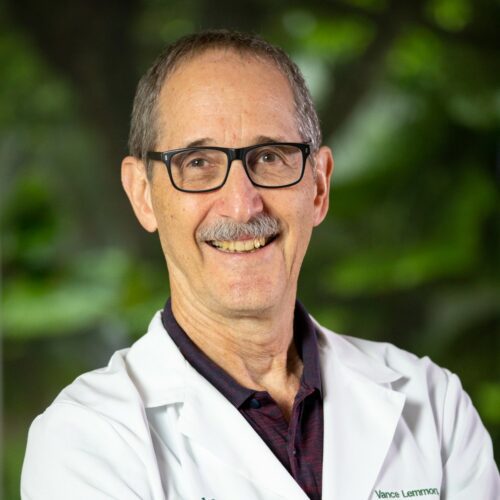
Vance Lemmon, Ph.D.
Walter G. Ross Distinguished Chair in Developmental Neuroscience
Professor, Department of Neurological Surgery
The Miami Project to Cure Paralysis
1095 NW 14th Terrace (R-48)
Miami, FL 33136
Dr. Lemmon received a PhD. in Anatomy from Emory University and did a post-doc at Washington University in St. Louis studying the development of the visual system and making monoclonal antibodies to the retina. Subsequently he studied cell adhesion molecules in neural development as a faculty member at the Medical University of South Carolina, the University of Pittsburgh and Case Western Reserve University. In 2003 he joined the Miami Project to Cure Paralysis. He holds the Walter G. Ross Distinguished Chair in Developmental Neuroscience.
Dr. Lemmon’s core research activities currently involve the use of phenotypic screening to identify genes and compounds that can be developed into therapeutics for nervous system repair. His lab with John Bixby and Hassan Ali uses automated microscopy and image analysis to measure how different treatments alter neuronal shape, especially the lengths and branching of neurites. The team has made extensive use of gene expression data (microarrays, RNAseq, ChIPSeq) and machine learning algorithms to identify novel targets for axon regeneration. A successful project with Murray Blackmore, Darcie Moore and Jeff Goldberg identified KLF transcription factors as key regulators of axon regeneration in the mammalian CNS (PMID: 19815778, 20159039, 22529377).
The Ali-Bixby-Lemmon team has also been interested in kinases as regulators of axon growth for many years (PMID: 8383619, 8663493, 2561968, 20664637, 17500509, 33318207). Dr. Lemmon has been publishing on kinases and axon growth since 1993 and Dr. Bixby has since 1989. They began screening kinases for roles in axon growth in 2007. A screen of a collection of kinase inhibitors identified one, RO48, that was able to promote growth of corticospinal tract axons after a CNS injury (PMID: 26056718). This work was done in collaboration with Jae Lee’s lab at the Miami Project. The effectiveness of this compound is thought to be due to favorable polypharmacology; inhibiting kinases both in pathways that mediate signals from inhibitory environmental factors and from intrinsic networks that limit axon growth. Subsequent in vivo studies with Xiao-Ming Xu and his lab members Wei Wu, Yan Sun, and Ying Ding, demonstrated that RO48 was effective in different injury models at improving axon growth and behavioral recovery (PMID: 28626016, 35588791). In 2022 the team received an NINDS Blueprint Neurotherapeutics Network award (UG3/UH3 NS124630) to use RO48 as a starting point in developing a novel therapeutic for spinal cord injury (SCI). In 2026, the team received funding for the 5th year of the project, based on good efficacy data with the new clinical candidate, TMP-316 (BPN-0037316)
The team’s various high throughput experiments had the unintended consequence of the group becoming involved in several projects related to informatics and reporting standards. The first project produced the BioAssay Ontology. Next came a project to create an ontology to describe nerve regeneration, the RegenBase Project (PMID: 27055827), including a reporting standard for SCI called MIASCI (PMID: 24870067). Dr. Lemmon is currently working with John Bixby, Karim Fouad, Adam Ferguson, and others on the Open Data Commons for SCI, and they were recently awarded a grant to integrate information across the TBI and SCI fields.
In his spare time, he likes to ride a bike or go sailing.
This is amazing Click on Lord Adrian and look up 4 levels.
High Content Screening and Functional Genomics of the Nervous System
In 2003 I merged labs with John Bixby, and we began to use various strategies, especially phenotypic screening, to hunt of targets or perturbagens (compounds, drugs, cDNAs, siRNAs, etc) that could help improve axon regeneration after injury to the mammalian CNS.
We have pursued 5 large projects over the past 20 years: 1) genes differentially expressed between the PNS and CNS (PNS can regenerate axons; the CNS? Not so much), 2) developmentally regulated genes (the immature CNS can regenerate axons but the adult CNS can’t), 3) genes differentially expressed in the PNS after a conditioning lesion, which enhances axon regeneration, 4) a crazy, large screen of millions of compounds, and last but not least 5) Kinases – they regulate virtually all biological processes and represent a target rich family of genes with thousands of kinase inhibitors that can be used to explore this biological space.
The first project springs from the fact that neurons in the peripheral nervous system can regenerate axons while neurons in the central nervous system (CNS) are not. By analyzing data from several molecular biological approaches, including RNA-seq, we were able to identify genes that are differentially expressed in regenerating peripheral neurons; of particular interest is a set of transcription factors (TFs) that are likely to regulate expression of other genes. We have focused on Stat3 for several years and have shown that by fusing it to a viral activation domain, we can substantially boost axon regeneration of optic nerve axons and sprouting of CST axons (Exp Neurol. 2016 PMID: 27060489).
Our second project is based on the fact that young CNS neurons have a greater regenerative capacity than old CNS neurons (collaboration with Dr. Murray Blackmore and Dr. Jeff Goldberg). We used DNA microarray data to generate a list of 800 candidate genes. We tested genes on our list in our High Content Screening platform and identified KLF transcription factors as key regulators of axon regeneration in the mammalian CNS (Science. 2009 PMID: 19815778, Mol Cell Neurosci. 2010 PMID: 20159039, Proc Natl Acad Sci U S A. 2012 PMID: 22529377).
The conditioning lesion paradigm was the basis for a fun collaboration with the Simon DiGiovanni lab (Science, Nat Communications, Nature Neuroscience, EMBO J, Sci Trans Med, Nat Cell Biology). Thank you to the amazing Matt Danzi (17 co-authored papers – crazy). Did you know exercise is really good for you (PMID: 30971452)?
If you want to pretend you are big pharma – screen clever pools of compounds with the people at Torrey Pines Research Institute (now part of FIU). Our team, led by Hassan Ali, identified some compounds that promote neurite growth in vitro. We are studying them in vivo now, thanks to support from the Craig H. Neilsen Foundation.
The last project involves Kinase Inhibitors (KIs) to promote control axon regeneration. This project with Dr. Hassan Ali, uses clever information and artificial intelligence algorithms to both identify kinases that should be inhibited and kinases that must be avoided to stimulate axon regeneration. We screened over 1600 KIs and found a number that have very large effects in vitro. One, RO48, has shown strong axon regeneration and sprouting effects in vivo and is serving as a basis for a medicinal chemistry program. The in vivo experiments are being done with Jae Lee at The Miami Project and Xiao-Ming Xu, at Indiana University (ACS Chem Biol. 2015 PMID: 26056718, Assay Drug Dev Technol. 2015 PMID: 26230074, J Neurosci. 2017 PMID: 28626016, Exp Neurol. 2022 PMID: 35588791). Due to strong preliminary data, we got a Blueprint Neurotherapeutics Network (BPN) project to turn RO48 into a drug for SCI. The BPN grants are milestone driven. You can be thrown out at the end of each year if you miss a single milestone. Astonishingly, we have made it to year 5, based on good efficacy data with our new clinical candidate, TMP-316 (BPN-0037316) in year 4. Now we have started dose-range-finding studies. Stay tuned for news about an IND submission.
All of our high throughput experiments have had the unintended consequence of our lab becoming involved in various informatics and reporting standards projects done with Stephan Schürer, Nigam Shah, Alison Callahan, Adam Ferguson and Karim Fouad (PMID: 21471461, PMID: 21702939, PMID: 24870067, PMID: 2705582, PMID: 28576567, PMID: 31608767, PMID: 40918992 and others). I think the ODC-SCI project (https://odc-sci.org/) is especially important and the NINDS’ NeuroTrauma PREclinical CDE and Data Standard program (https://www.ninds.nih.gov/node/10471) will accelerate data sharing and new discoveries.
Key technologies: High Content Analysis, deep sequencing & informatics, tissue clearing, fluorescent light sheet microscopy / ultramicroscopy
Visit Dr. Lemmon’s Publication Listing
News Stories
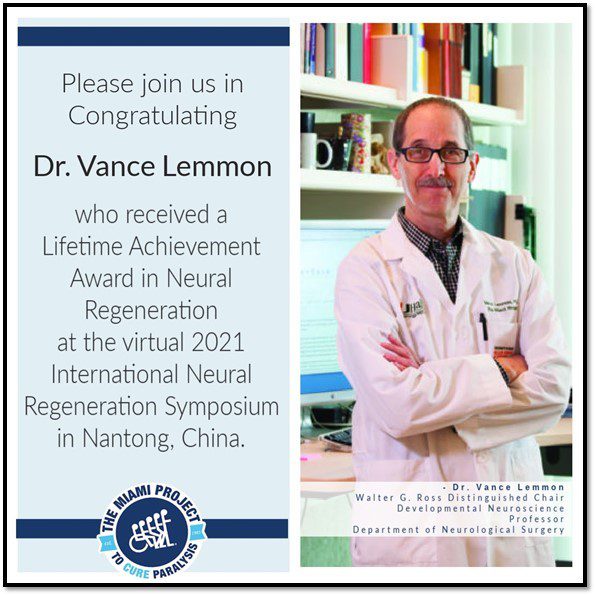
Dr. Vance Lemmon Awarded the Lifetime Achievement Award in Neural Regeneration (May 2022)
NIH/NINDS Blueprint Neurotherapeutics Network Grant (April 2022)
On the Edge of Discovery (December 2019)
Understanding the Challenges of Re-connecting Neurons after Spinal Cord Injury (October 2019)
Turbo Charging Discovery with High-Content Screening (September 2019)
Replication Studies and The Miami Project (July 2019)
Miami Project Researchers Launch Startup Truvitech (March 2018)
Industry and Academia: Drs. John Bixby, Vance Lemmon and Hassan Al-Ali (October 2016)
Miami Project Receives NIH Grant to Study Axon Regeneration (September 2016)
Research Journal Feature (September 2016)
PROFESSIONAL AFFILIATIONS/MEMBERSHIPS
Society for Neuroscience
American Association for the Advancement of Science