

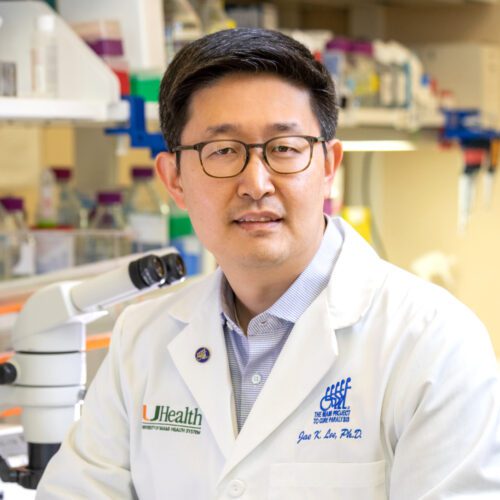
Jae K. Lee, Ph.D.
Christine E. Lynn Distinguished Professor in Neuroscience
Professor, Department of Neurological Surgery
The Miami Project to Cure Paralysis
1095 NW 14th Terrace (R-48)
Miami, FL 33136
Dr. Jae Lee received his BS and MS in Biology from George Washington University and his PhD in Neuroscience from Georgetown University, where he investigated plasticity of local reflex circuits after spinal cord injury in the laboratory of Dr. Jean Wrathall. He continued his training as a postdoctoral fellow in Dr. Binhai Zheng’s laboratory at the University of California San Diego, where he studied the role of myelin-associated inhibitors and chemorepulsive axon guidance molecules in inhibition of axon regeneration.
Dr. Lee joined The Miami Project to Cure Paralysis at the University of Miami School of Medicine as an Assistant Professor and rose through the ranks to be named the Christine E. Lynn Distinguished Professor in Neuroscience and the Associate Director of The Miami Project. Dr. Lee serves on the editorial boards of Experimental Neurology and the Open Data Commons for Spinal Cord Injury. He has served as a standing member of the NIH Clinical Neuroplasticity and Neurotransmitter (CNNT) study section and reviews grants for many other state, federal, and private agencies. Dr. Lee has been recognized with the University of Miami Neuroscience Graduate Program Award for Excellence in Teaching and the Faculty Mentor of the Year Award.
Wound Healing, Scarring, and Regeneration After CNS Injury
The overarching goal of our laboratory is to develop effective strategies to repair the injured spinal cord. Our work focuses on elucidating the cellular and molecular mechanisms underlying the wound healing process following spinal cord injury (SCI), investigating the dynamic cellular interactions and heterogeneity that govern inflammation, cell proliferation, and tissue remodeling.
Fibrotic and Glial Scar Formation: A hallmark of traumatic CNS injuries is the formation of a dense scar at the injury site that inhibits tissue repair and axon regeneration. Our laboratory identified Col1a1-positive perivascular fibroblasts as the principal source of the fibrotic scar after spinal cord injury, shifting the field’s understanding of scar composition beyond glial elements. We subsequently demonstrated that monocyte-derived macrophages play a central role in fibrotic scar formation and that their depletion reduces fibrosis and promotes axonal growth. We continue to explore how fibrotic scarring affects repair across CNS pathologies, including stroke and autoimmune demyelination models.
Macrophage Biology and Lipid Metabolism: Our lab is interested in understanding macrophage heterogeneity and function after SCI. We performed the first macrophage-specific RNA sequencing study in SCI, revealing that macrophage transcriptional profiles closely mirror those of lipid-laden foamy macrophages found in atherosclerotic lesions, and identifying key lipid catabolic signaling pathways as therapeutic targets. We subsequently developed novel assays demonstrating that spinal cord injury debris drives the formation of foamy macrophages and identified PI3K signaling as a key regulator of this process. These studies have established new mechanistic links between injury-induced debris and chronic macrophage pathology and are guiding our current drug discovery efforts targeting lipid-laden macrophages.
Single-Cell and Spatial Transcriptomics: To capture the full cellular complexity of the injured spinal cord, our lab uses cutting-edge single-cell and spatial transcriptomic technologies. Our single-cell atlas of the injured mouse spinal cord uncovered unappreciated heterogeneity in myeloid, glial, and vascular cells, and mapped the intercellular signaling networks that regulate scar formation. We have extended these approaches to other injury models, including traumatic brain injury and stroke. Our lab continues to integrate single-cell and spatial transcriptomics with computational modeling and functional validation to build a comprehensive CNS injury cell atlas.
Visit Dr. Lee’s Publication Listing
News Stories
Miami Project Researcher Receives $6 Million NIH Grant (August 2023)
NIH/NINDS Blueprint Neurotherapeutics Network Grant (April 2022)
Miami Project Researchers Publish on Wound Healing in JEM (June 2021)
Dr. Dalton Dietrich and Colleagues Receive $1.6 Million NIH Award (06/30/2016)
New Axon Sprouting Research Findings Published (11/09/2014)
Researchers Receive New Defense Funding for Axon Regeneration and Spinal Cord Injury Research (June 2013)
PROFESSIONAL AFFILIATIONS/MEMBERSHIPS
Society for Neuroscience