

Helen M. Bramlett, Ph.D.
Professor, Department of Neurological Surgery
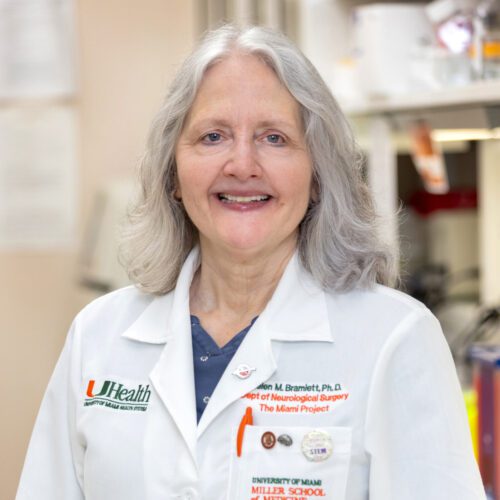
The Miami Project to Cure Paralysis
1095 NW 14th Terrace (R-48)
Miami, FL 33136
Dr. Helen Bramlett received her bachelor’s degree in Psychology at the University of Texas at Austin, her MS in Psychology at the University of Louisiana at Monroe and her MS and PhD degree in Behavioral Neuroscience from the University of Miami. She completed her postdoctoral work in Neurotrauma at the University of Miami and she received a postdoctoral fellowship award from the American Heart Association.
Dr. Bramlett is actively involved in undergraduate teaching and serves as Director of the Undergraduate Neuroscience Program at the University of Miami. Dr. Bramlett is an internationally recognized scientist with over 20 years’ experience in the field of CNS injury including the pathophysiology and treatment of traumatic brain and spinal cord injury as well as stroke. She is currently funded by NIH, DOD, the State of Florida and the VA. Dr. Bramlett serves on several national review boards and is on the Editorial Board of Journal of Neurotrauma and Translational Stroke Research. She is the Managing Editor of Therapeutic Hypothermia and Temperature Management. She is Editor-in-Chief of Neurotrauma Reports, the Open Access companion journal to Journal of Neurotrauma. She is a founding member of the InflamaCORE, LLC, a company dedicated to treating and diagnosing inflammatory injury and disease.
The Pathophysiology and Treatment of CNS Injury
My research spans neurotrauma, neurodegeneration, ischemia, and spinal cord injury, with major thematic strengths in inflammasome biology, sex‑ and age‑dependent vulnerability, therapeutic hypothermia, extracellular vesicle therapies, neuroprotective molecules, and transcriptomic/proteomic characterization of injury responses.
A substantial portion of my collaborative work defines how inflammasome signaling contributes to secondary injury mechanisms in TBI, stroke, Alzheimer’s disease (AD), neurodevelopmental injury, and gut–brain axis disruption. These studies demonstrated region‑specific inflammasome protein expression, genetic modulation of pyroptosis pathways (e.g., GSDMD knockout), and how peripheral factor such as stool‑derived extracellular vesicle amplify CNS inflammation after TBI and stroke, including in AD‑transgenic mice.
Our group has made multiple advances in cell‑ and vesicle‑based therapies for neurotrauma, showing that human Schwann cell‑derived exosomes and neural stem cells mitigate microglial activation, histopathology, and behavioral deficits after penetrating or blunt brain injury. Similar work examines biomarker responses and injury severity correlations in acute traumatic spinal cord injury.
We have also contributed extensively to investigations of therapeutic hypothermia and temperature modulation, including novel approaches using nanovanilloid‑mediated targeted cooling and single‑cell RNA sequencing to map cell‑type‑specific hypothermia responses after TBI.
A strong mechanistic theme in my research involves hormonal, metabolic, and sex‑dependent influences on CNS injury. These studies show how menopause‑associated frailty, estrogen receptor‑β signaling, nicotine/contraceptive interactions, and electronic cigarette vapor exposure alter ischemic outcome, neuronal survival, inflammatory signaling, and behavioral recovery, often with marked female-specific vulnerabilities.
Our work on ischemia includes discoveries that recombinant irisin and whole‑body vibration therapy can induce transcriptomic profiles associated with neuroprotection and ischemic tolerance in middle‑aged or reproductively senescent animals. Complementary studies identify interactions between metabolic hormones (e.g., osteocalcin) and brain senescence.
Another major emphasis is systems-level characterization of CNS injury. We have led or contributed to multimodal MRI, neuroproteomics, machine learning–based recovery prediction, and circulating biomarker analyses across models of TBI and SCI. These studies reveal longitudinal patterns of structural change, electrophysiological abnormalities, and predictive biomarker signatures linked to injury severity and outcome.
Finally, our research extends into bone biology after spinal cord injury, demonstrating how low‑intensity vibration and RANKL inhibition reduce immobilization‑induced bone loss, broadening the translational relevance beyond CNS tissue.
Visit Dr. Bramlett’s Publication Listing
News Stories
Dr. Bramlett quoted in Psychology Today (February 2023)
Dr. Bramlett Named Neurotrauma Reports Editor-in-Chief (April 2020)
Miami Project and UM Concussion Research with Scythian Biosciences (07/2018)
Industry and Academia: Inflamacore, LLC (10/2016)
Research Journal Feature (09/2016)
Dr. Dalton Dietrich and Colleagues Receive $1.6 Million NIH Award (06/2016)
Scientists Receive NIH Funding to Move Novel Therapy Targets Forward (04/09/2014)
PROFESSIONAL AFFILIATIONS/MEMBERSHIPS
National Neurotrauma Society
Women in Neurotrauma Research
Miami Chapter, Society for Neuroscience
Women in Neurotrauma Research
International Neurotrauma Society
International Society of Cerebral Blood Flow and Metabolism
National Neurotrauma Society
Society for Neuroscience
Psi Chi
PATENTS
Modulating Inflammasome Activity and Inflammation in Central Nervous System Injury. Robert W. Keane, Ph.D., W. Dalton Dietrich, Ph.D., Juan Pablo de Rivero Vaccari, Ph.D., Helen M. Bramlett, Ph.D. US Patent Application No. 12/182,886