

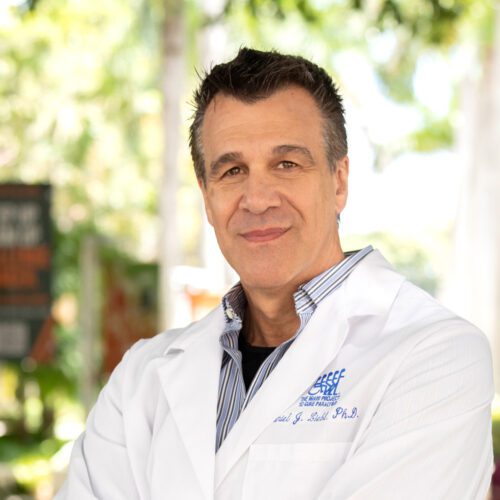
Daniel J. Liebl, Ph.D.
Professor, Department of Neurological Surgery
The Miami Project to Cure Paralysis
1095 NW 14th Terrace (R-48)
Miami, FL 33136
Dr. Daniel Liebl received his PhD from Kent State University in 1994 in Neuroscience in the laboratory of Dr. Peter Koo. He investigated the role of alpha-2-macroglobulin in neuronal growth and survival. In 1994, he joined the laboratory of Dr. Luis Parada and examined the role of neurotrophins and their receptors in developing peripheral and central nervous systems at the University of Texas Southwestern Medical Center.
During his post-doctoral training, Dr. Liebl became a member of the Christopher and Dana Reeves Paralysis Consortium and was promoted to a faculty instructor in 1997. This led to Dr. Liebl’s interest in CNS trauma, and he joined The Miami Project to Cure Paralysis, University of Miami Miller School of Medicine (UMMSM) in 2000 as an Assistant Professor. Dr. Liebl was promoted to Associate Professor with Tenure in 2007 and to a full Professor in 2012 at UMMSM. Dr. Liebl served as Director of the Neuroscience Program from 2008 to 2013 and Associate Director of the MD/PhD Medical Student Training Program (MSTP) in 2020. In 2022, he became the co-Director of the MSTP.
Molecular Mechanisms that Regulate Cellular Dysfunction and Regeneration Following CNS Injury
Our overall goal is to gain a better understanding of how the injured central nervous system responds to traumatic injury, such as brain and spinal cord injury, and neurodegenerative diseases, such as Alzheimer’s disease and multiple sclerosis. Protecting the brain and spinal cord from progressive damage and promoting restoration are important for improving patient recovery. My laboratory has focused on three specific areas of interest: (1) identifying a novel mechanism of synaptic damage, plasticity, and regeneration; (2) examining the role of cholesterol and other lipids in CNS damage and repair; and (3) evaluating the role of circadian rhythms in CNS injury. To examine these functions, we take advantage of genetic mouse models, where we can examine the mechanisms of action within a complex and evolving injury environment using loss-of-function, gain-of-function, and return-of-function approaches. In addition, we are very interested in translating our findings to patients and thus exploring drug development and examining human patient samples. To accomplish our goals, we employ a variety of approaches, including molecular, biochemical, genetic, cellular, behavioral, and physiological analyses, as well as computational, high-throughput, and multiomic approaches to identify novel regulators of CNS recovery.
- Synaptic Protection and Regeneration: Many functional defects associated with CNS injury result from synaptic damage and loss throughout the brain. In particular, progressive synaptic damage occurs not only around the injury site but also in distal regions. We have developed a controlled cortical impact injury mouse model that results in synaptic damage in the hippocampus without neuronal cell death to examine synaptic stability, de-innervation, and re-innervation. We have identified a mechanism of synaptic damage that results in the re-activation of dormant developmental pruning processes. We are currently analyzingother traumatic injury models, concussive brain injury, and neurodegenerative models to determine whether these mechanisms of cognitive dysfunction underlie dementia and other behavioral defects associated with diseases and disorders. In addition, we are developing novel drug candidates to inhibit these mechanisms and translate them to patients in the future.
- Intracellular membrane homeostasis: There has been a great deal of research in understanding the overall pathophysiology of CNS trauma, but little understanding of the mechanism that regulate membrane integrity and functions. Cholesterol comprises 70% of a cellmembrane and plays vital roles in survival, signaling, migration, and growth. Much of our current knowledge of cholesterol homeostasis comes from the developing nervous system; however, very little is known about how alterations in cholesterol homeostasis affect cellular functions. We employed state-of-the-art approaches to examine the mechanisms underlying cholesterol and overall sterol regulation in two models: controlled cortical impact (CCI) injury, which models traumatic brain injury, and experimental autoimmune encephalomyelitis (EAE), an animal model of multiple sclerosis.
- Circadian Rhythms and CNS injury: We will examine the role of circadian rhythms in TBI pathology, focusing on the molecular clock mechanism and its core transcriptional activator, BMAL1. We hypothesize that fluctuating BMAL1 levels contribute to cell death, glial activation, and cognitive impairment in TBI. Our innovative approach combines time-based analysis with advanced pathological techniques to explore the relationship between circadian regulation and TBI. The study aims to examine clock-dependent regulation of TBI pathologies in the cortex and hippocampus using cell-specific conditional knockout mouse lines during period of damage and recovery. In short, this research will provide crucial insights into the molecular mechanisms underlying TBI and potentially lead to novel chronotherapy-based treatments for improved patient outcomes.
Visit Dr. Liebl’s Publication Listing
News Stories
Miami Project Researchers Awarded 5-Year $2.2 Million NINDS TBI Grant (August 2017)