

DRUG DISCOVERY CORE
The Miami Project to Cure Paralysis
Lois Pope LIFE Center Building Room 4-01
1095 NW 14th Terrace
Miami, FL 33136
Please email questions to: mxg2955@med.miami.edu
Opera Phenix Calendar
Use this calendar to book time on the Opera Phenix. Please make sure to input the correct account number.
Cite the DDC Core
If you use DDCcore services in your work, we kindly ask that you cite the core in the relevant publications. Click the button above for the correct citation to include in the Acknowledgments section of your publication.
CORE DIRECTOR
Hassan A Ali, Ph.D., M.S.M.
halali@med.miami.edu
305-243-8491
CORE MANAGER
Mahesh Gokara, Ph.D.
mxg2955@med.miami.edu
305-243-8506
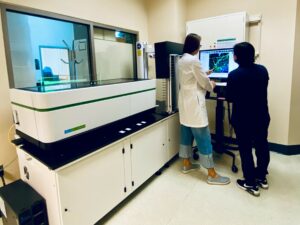
The Drug Discovery Core (DDC) at The Miami Project to Cure Paralysis leverages the PerkinElmer Opera Phenix Plus high content screening (HCS) platform to provide researchers with state-of-the-art assay development and phenotypic screening capabilities. The facility is also equipped with a PerkinElmer Janus G3 liquid handler, featuring modular and variable dispense heads, and a Promega GloMax Discover multimode microplate reader for luminescence, fluorescence, and absorbance detection, automate screening workflows and enhance throughput. Supporting infrastructure, including biosafety cabinets (BSCs), CO₂ incubators, and a plate washer, is also available on site so that users can prepare, maintain, and store the plates they bring to the core before and between imaging runs. The core supports a wide range of phenotypic and target-based assays. Phenotypic assays range from 2D to 3D, widefield to confocal, and antibody to dye based. It collaborates with users to develop customized assays and analytical pipelines tailored to their specific needs. Current specializations include neurite tracing, lipid droplet quantification, cell viability, morphological and kinetic analyses, phagocytosis, cell marker detection, cell adhesion, among others.
Additionally, the core is implementing Cell Painting technology for phenotypic screening. Cell Painting is a cutting-edge, unbiased screening technology applicable to cell-based assays without prior knowledge of disease phenotype. This technique uses a suite of fluorescent dyes to stain cellular organelles for phenotypic profiling in 96- and 384-well plates. The Phenix platform captures images of the painted cells, followed by automated image analysis to extract over 2000 morphological features (such as size, shape, texture, and intensity) from each cell. Feature selection is then conducted to identify attributes that distinguish cells under various conditions (e.g., diseased vs. healthy cells). These identified features can be used to screen libraries of small molecule compounds, identifying those that revert the disease phenotype to a healthy state. This platform offers a truly unbiased, high-throughput, and massively parallel discovery system, accelerating drug discovery even before the biological mechanisms of a disease are fully understood.

SERVICES AND EXPERTISE
DDC Technical Consultation Service
COSTS
$85 per hour for University of Miami users.
$130 per hour for non-UM (external) Academic users.
Provides expertise and know-how specific to the successful planning, imaging, and analysis of plates for high content screening projects. For UM faculty, the initial consultation (30 minutes) is free.
Assay Development and Screening
$132 per hour for University of Miami users.
$203 per hour for non-UM (external) Academic users.
Provides consultation and hands-on support for developing, optimizing, and screening customized phenotypic and target-based assays tailored to the user’s research needs.
DDC Setup Fee
$185 per hour for University of Miami users.
$284 per hour for non-UM (external) Academic users.
This service charge includes staff and machine time. This service charge is associated with setting up a test plate prior to the first experimental run. The service involves configuring appropriate machine parameters (SNR, filter settings, and other software settings) to optimize image acquisition and generate reliable and relevant output/data.
Batch Run Setup Fee
$90 per hour for University of Miami users.
$138 per hour for non-UM (external) Academic users.
This service charge includes staff and machine time. This service charge is associated with setting up the HCS machine to run a batch of plates. Before running a batch of plates, qualification of the initial plate is conducted to ensure that previously determined settings and parameters are still appropriate for the batch of plates. This ensures the batch run will result in good output.
DDC Instrument Fee
$180 per hour for University of Miami users (min. charge $45.00).
$250 per hour for non-UM (external) Academic users (min. charge $62.50).
This service charge includes machine time for running the plates and manual verification of image quality. Minimum charge is fifteen (15) minutes. The charge is a function of number of plates and the time it takes to run each plate.
Image Processing and Analysis
$100 per hour for University of Miami users.
$154 per hour for non-UM (external) Academic users.
This service charge is for personnel time involved in processing the large data files generated after running the customer’s plates. Each plate generates data that is reviewed for quality control purposes.
Self-Service Image Analysis and Data Export
$30 per hour for University of Miami users.
$46 per hour for non-UM (external) Academic users.
Provides access to a dedicated image analysis workstation for users to analyze their high content imaging data and export the analyzed results.
Janus Liquid Handling
$200 per hour for University of Miami users.
$300 per hour for non-UM (external) Academic users.
This service charge includes staff and machine time for automated liquid handling using the PerkinElmer Janus G3 to move reagents between multi-well plates.
Janus Robot Setup Fee
$200 per hour for University of Miami users.
$307 per hour for non-UM (external) Academic users.
This service charge includes staff and machine time. This service charge is associated with setting up a test plate on the Janus prior to the first experimental run.
GloMax Plate Reader
$40 per plate for University of Miami users.
$61 per plate for non-UM (external) Academic users.
This service charge includes staff and machine time. This service charge is associated with setting up a test plate on the Janus prior to the first experimental run.
FREQUENTLY ASKED QUESTIONS
1. When can I expect to get my results back?
Once a run is scheduled, the results will be delivered within a week, although in many cases the results will be available in 24-48 hours.
2. What do I need to provide for High Content Screening?
Please fill out the HCS Image Facility Request Form before you plan your experiment using the High Content Screening facility. The Opera Phenix from Perkin Elmer is capable of scanning 12 well/24well/48well/96 well/384 well/1536 well plates as well as coverslips. We recommend PerkinElmer CellCarrier and Greiner uClear plate for good optical quality. Other types of plates may be allowed but will either limit to imaging at low magnification or might require additional setup time for creating new form factors, at an increased expense. Please consult the facility manager before settling on a plate or coverslip arrangement. Please check staining/fluorescence quality before you bring your plates to the HCS core to insure a successful screening.
3. In what form are the results?
Results are typically provided in Excel or CSV format. For HCS results, the Perkin Elmer Harmony Software allows the user to access the images to ensure the quality of the samples. We can help users in interpretation of the results via the consultation service. As an option, we can use Spotfire DecisionSite software to perform analysis the data and provide PDF or PowerPoint file of the results and email them to the user.
Instructions are available for filling out the IDR Form.
4. How do I pay for use of the facility?
Payment for services is processed through Internal Service Delivery in UM Workday. When booking the instrument in the calendar, please ensure you provide the correct account number and primary investigator information. After the screening is complete, we will calculate the total service time and submit the invoice through UM Workday, with the final amount based on the actual time used.
5. Who is eligible to use the facility?
The DDC is open to all interested customers for a wide range of research projects. University users will have priority.
6. Can users from non-academic and industry entities utilize the facility?
Yes. Contact the Core Director to inquire about the non-academic rates.