

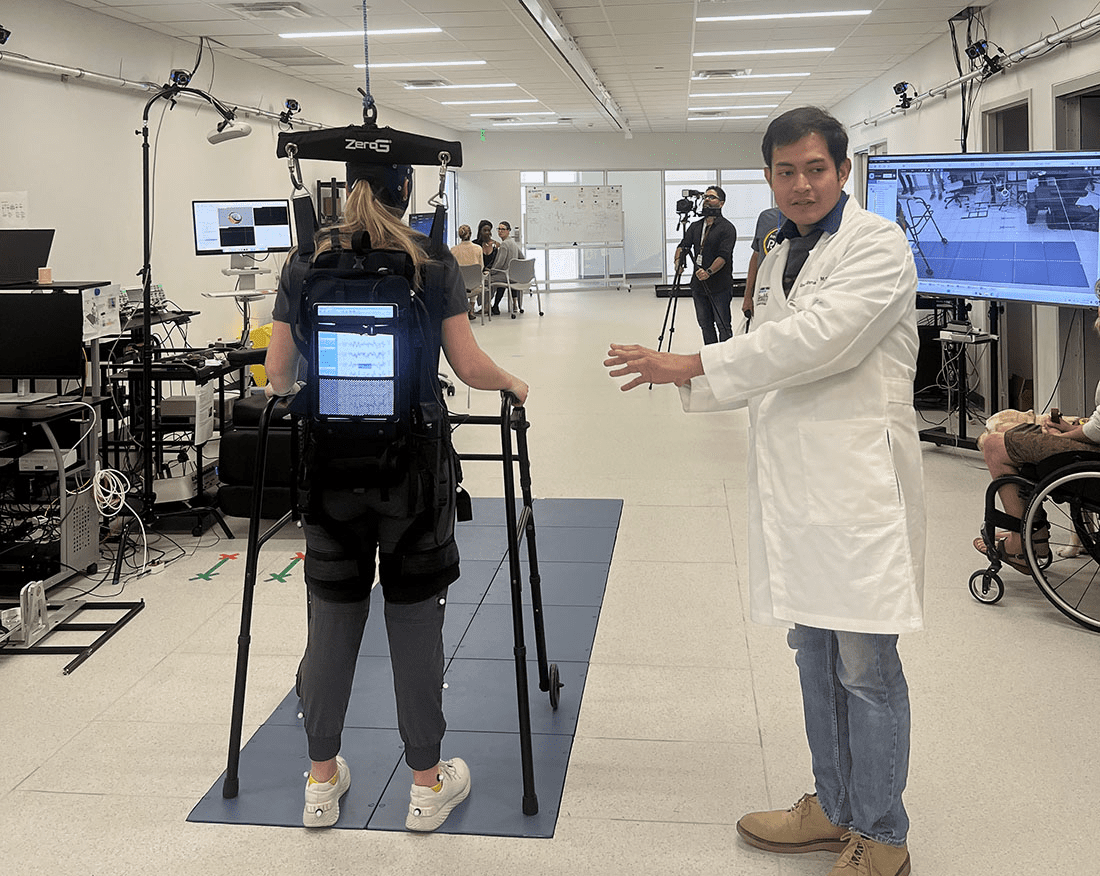
(August – 2025) – For most people, walking or lifting a coffee cup are simple acts they barely consider. But for those who have suffered spinal cord or brain injuries, including stroke, these simple tasks can be virtually impossible.
The Miami Project to Cure Paralysis, a Center of Excellence at the University of Miami Miller School of Medicine, is working to change that, and neuromodulation is one of their most innovative emerging tools. These techniques use small electrical currents to stimulate nerves. By combining the stimuli with rehabilitation, Miami Project researchers believe they can help patients improve their ability to walk and/or use their arms and hands.
“Neuromodulation seeks to activate the spinal cord or brain after injury to promote circuit restoration,” said W. Dalton Dietrich, Ph.D., the Miami Project’s scientific director. “Quite often, even after severe injury, there are residual circuits we can activate. We may not be able to restore full function, but we can help give patients more.”
The technology is promising, but there are still unanswered questions: What parts of the brain or spinal cord should be stimulated to improve specific functions? How much current should be applied and when? How should those signals be modulated so the central nervous system knows what they mean?
Miami Project researchers are combining expertise in neural engineering, neurosurgery, neurology, rehabilitation, and other disciplines to answer these and other questions.
“Neuromodulation can be applied in different ways,” said Dietrich. “Epidural stimulation can help by putting stimulators on the spinal cord surface while, for deep brain stimulation, electrodes are precisely positioned in deeper brain structures. Transcutaneous stimulation puts stimulators on the surface of the skin. Regardless of the modality, the goal is to find the right approach to help individual patients regain function and improve quality of life.”
Breaking the Neuromuscular Code
An extension of the brainstem, the spinal cord is organized into circuits that carry messages throughout the body. It contains pattern generators, sending rhythmic signals that control walking, breathing and other functions, as well as specific connections that allow precision arm and hand function.
“When walking along, you activate your generator,” said Brian Noga, Ph.D., professor in the Department of Neurological Surgery. “At the same time, sensory signals are coming in from your feet, legs and arms to update your brain on what’s happening in the real world. It’s an incredibly dynamic process.”
These inputs and outputs are processed in the mesocephalic locomotor region (MLR), which helps make sense of these disparate signals. Understanding the MLR is one key to helping people suffering from a spinal cord injury, stroke, Parkinson’s disease and other neurological issues.
Essentially, Dr. Noga and colleagues are acting as codebreakers, trying to understand these brain signals and replicate them with electrodes that stimulate nerve cells. Breaking the code will help clinicians send signals the body understands.
“We want to find the electrical stimulation thresholds that initiate walking and continue it,” said Dr. Noga. “We have found that it’s not just a single pathway that produces walking. There is a command pathway and another, parallel, pathway. And we’ve shown that if we stimulate this other pathway, we can affect locomotion.”
Reengaging Arms and Hands
James Guest, M.D., Ph.D., professor of Neurological Surgery, led the Miami Project’s collaboration in Up-LIFT, a multi-center study that evaluated transcutaneous spinal cord stimulation (tSCS) to improve upper extremity function in people with chronic spinal cord injuries.
While some forms of neuromodulation use implanted devices, tSCS is completely noninvasive: the instrument uses electrodes on the skin to send currents into the spinal cord. Up-LIFT combined neuromodulation with intensive arm and hand rehabilitation, stimulating neural circuits as they were being used.
“Typically, after spinal cord injury these circuits don’t activate properly and remain below the electrical threshold,” said Dr. Guest. “We’re giving them that added push to become effective. Also, transcutaneous stimulation is easy to do, which means there’s a good chance it will enter practice.”
Early results have been promising. Up-Lift showed tSCS can be both safe and effective, improving upper extremity function in many patients. Moving forward, Dr. Guest would like to use tSCS for other conditions, such as spasticity. By testing different electrical frequencies, he hopes to find the right combination of signals to help specific patients.
Stimulating the Vagus Nerve
Patrick Ganzer, Ph.D., has a dual appointment at the Miami Project and the Department of Biomedical Engineering and is taking a slightly different approach to neuromodulation. His group is implanting a small electrical device on the vagus nerve, which promotes neural circuit changes and the parasympathetic nervous system, which controls the heart, digestion and other autonomic functions.
“Our lab is focused on peripheral nerve stimulation to enhance the effects of rehabilitation and improve upper limb function,” said Dr. Ganzer.
The team often uses sensorized objects, like small pucks rehab patients can manipulate in their hands or small handles they can pull to measure forelimb strength. The embedded sensors record the object’s state, which can inform the neuromodulation parameters to provide the most efficient and timely nerve stimulation.
“Our nerve stimulation is reactive to movement events during rehabilitation, so we can record signals, such as force and angle, from the objects being manipulated during rehab,” said Dr. Ganzer. “It is possible to measure many signals during rehabilitation, process them, and use a smart algorithm to trigger optimal stimulation.”
Researchers stimulate the nerve for around half a second, which releases neurotransmitters that promote neural circuit change (neuroplasticity). But the stimulation must be paired with a “good event,” such as a patient handling a sensorized object in a specific way. Through this process, neuromodulation gives nerves special reinforcement to encourage nervous system change and increase the capacity for improved movements.
“Stimulating the nerve releases molecules that provide reinforcement when the brain learns something,” said Dr. Ganzer. “We are trying to reinforce good brain activity during good movements.”
The Ganzer lab is now working with a quadriplegia model to better understand how vagus nerve stimulation can improve function. This research could also have applications beyond movement. Because the vagus controls autonomic functions, stimulating it could improve a variety of conditions.
“We may not think about it, but beyond muscles there are many other events within a broad array of organs, and when these don’t work properly, there can be all kinds of health issues,” said Dr. Ganzer. “We believe we can generate more brain connections with this therapy to enhance broader organ control.”
Improving Walking
The Miami Project’s newest faculty member, Assistant Professor of Neurological Surgery and Director of Neuromotor Rehabilitation Matija Milosevic, Ph.D., is looking for ways to use a patient’s own brain waves to help restore movement.
“We use non-invasive electroencephalogram (EEG) signals to record electrical activity from the motor areas of the brain,” said Dr. Milosevic. “This helps us detect a person’s intent to move their arms or legs. They cannot complete the movement, because of their injuries, but we can apply transcutaneous spinal cord stimulation to, hopefully, translate those brain signals into motion.”
A form of neural modulation, brain-computer interface (BCI) approaches are another exciting strategy to “teach” a patient’s remaining connections to produce more powerful signals. In an upcoming pilot trial, the team will test whether combining BCI, tSCS and physical therapy will help people with incomplete spinal cord injuries walk better.
“We’re bypassing the injury, but we’re also providing positive reinforcement to strengthen existing connections,” said Dr. Milosevic. After the therapy, these individuals won’t have to rely on the technology; we’re hoping to reanimate residual connections and potentially create new ones.”
The Future of Neuromodulation
The Miami Project and colleagues worldwide have made great progress stimulating nerves to restore function, but there’s still work to be done. Dr. Dietrich envisions neuromodulation will be one of many clinical tools that help patients recover from brain and spinal cord injuries and neurodegenerative disorders.
“We are developing multidisciplinary approaches to improve function in these serious conditions,” he said. “In acute injuries, surgical procedures combined with neuroprotective strategies, such as targeted temperature management, are being used to reduce structural damage. In parallel, cell-based therapies to promote circuit rewiring and drug discovery programs identifying novel compounds to regenerate circuits are making exciting discoveries. Ultimately, neuromodulation could make each patient’s circuits more functional.”