

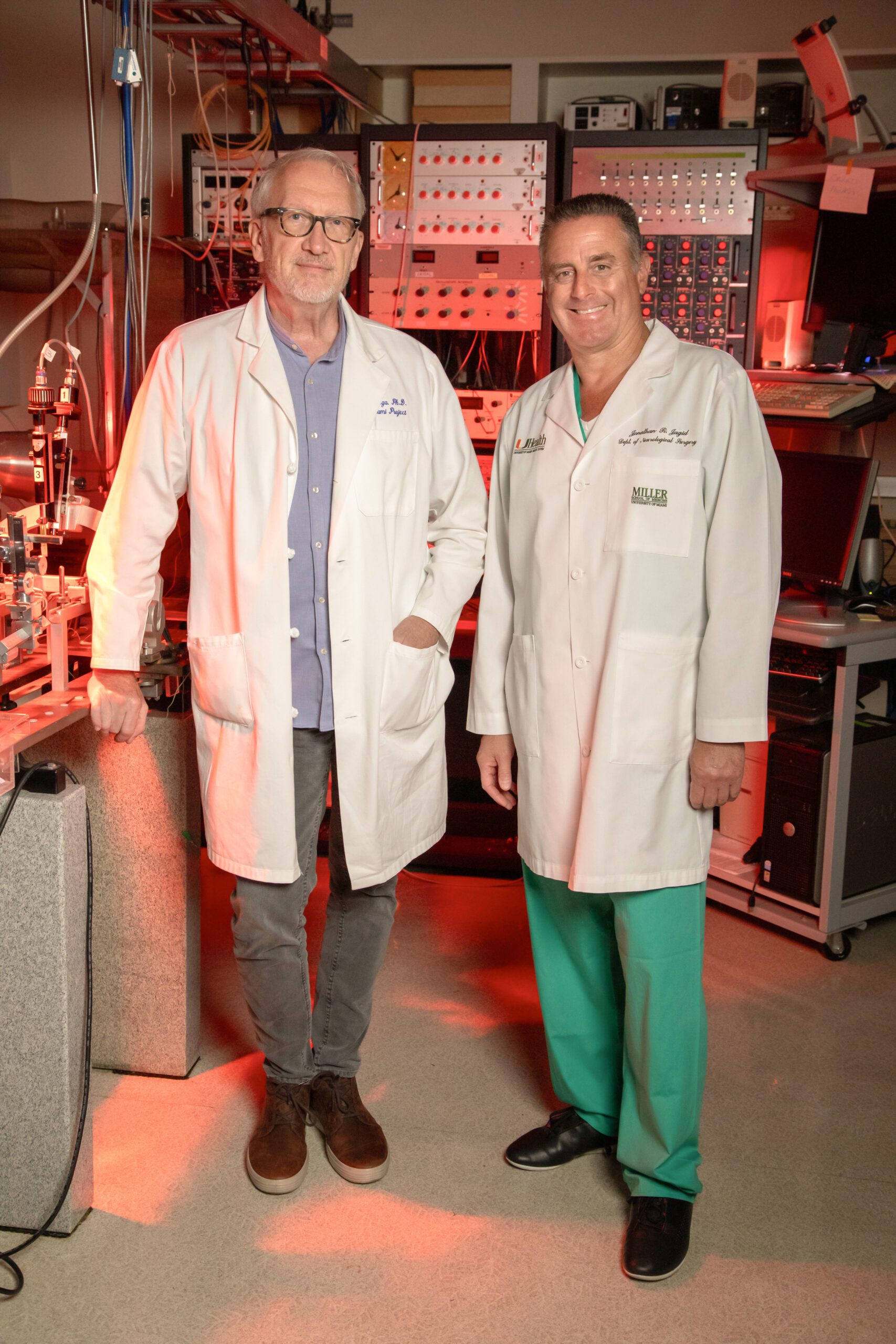
(December 2025) The Miami Project’s Jonathan Jagid, M.D. and Brian Noga, Ph.D. have established a strong foundation in deep brain stimulation (DBS) for movement disorders. Their collaborative expertise, honed through years of research and clinical work, is now driving a significant expansion: leveraging DBS not only for Parkinson’s but also for individuals living with spinal cord injury (SCI).
DBS has long been a beacon of hope for people with Parkinson’s, and the Miami team have used it successfully with those experiencing “freezing of gait” (FOG)—a sudden inability to move despite the intention to walk. While medications and traditional DBS approaches have helped many, some remain unresponsive. The Miami Project’s team, however, has optimized DBS protocols, targeting specific brain regions to unlock movement and restore mobility.
Building on these positive outcomes, the research program is now expanding. The team is extending their clinical studies to include individuals with SCI, aiming to translate the remarkable gains seen in Parkinson’s to those affected by paralysis. This expansion is grounded in both scientific discovery and engineering innovation. Dr. Noga’s pre-clinical research has mapped the brain and spinal circuits responsible for walking, while Dr. Jagid’s clinical expertise has refined the surgical delivery of DBS.
A key focus is the mesencephalic locomotor region (MLR), particularly the cuneiform nucleus (CnF), which plays a central role in initiating and controlling walking. The team’s ongoing pilot clinical trial uses advanced directional DBS probes to precisely stimulate the CnF, minimizing off-target effects and maximizing therapeutic benefit. Results in Parkinson’s patients have been promising, and with several participants already implanted, the new study is enrolling individuals with incomplete SCI to assess safety, feasibility, and efficacy in this population. Currently, this study is the only one of its kind in North America.
The clinical study is now actively seeking participants to help advance this groundbreaking research. If you or someone you know is interested, the study is looking for individuals who meet the following criteria:
* Ages 22–65
* Spinal cord injury at T10 or above
* Incomplete SCI
* Able to stand for at least 5 minutes with some support
This expansion marks a pivotal moment in neurosurgical research. The journey from treating FOG in Parkinson’s to restoring walking in SCI is a testament to the power of translational science and interdisciplinary collaboration. Each step forward brings the vision of renewed mobility—and renewed hope—closer for those living with paralysis.